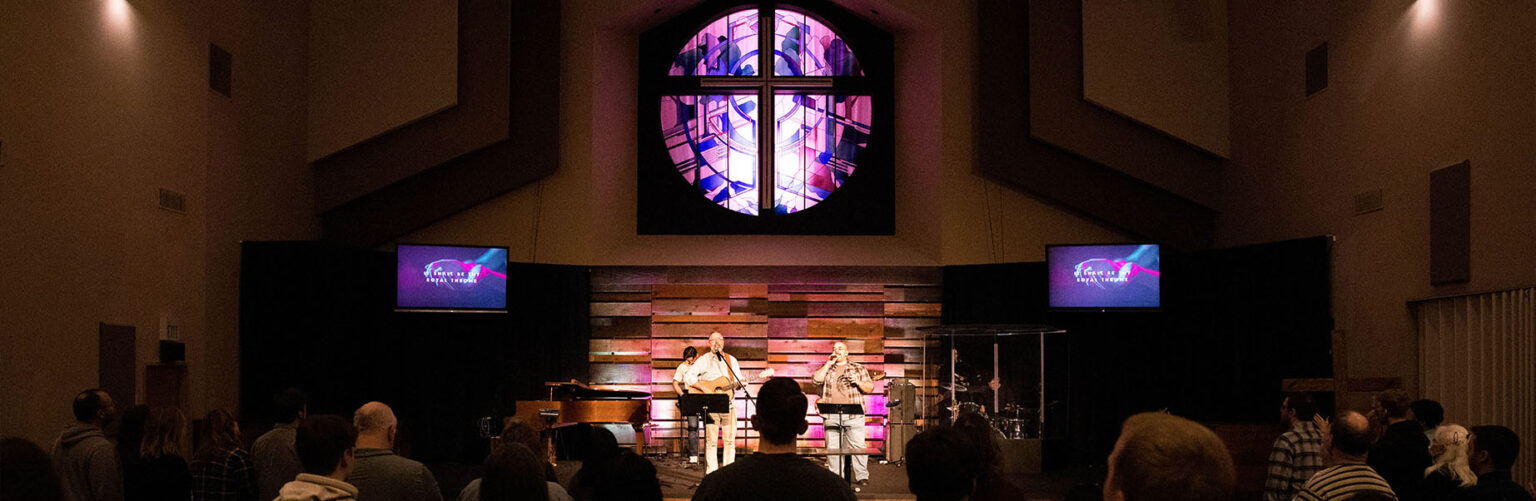
Communion Church
In the Fall of 2010, I sensed a call from God to plant a church in Mount Vernon. At the time, I was a pastor at Damascus Road Church in Marysville — I had just gone from being a part-time pastor (with two other jobs) to being a full-time pastor of the church. I had just found stability after a few years of chaos. Starting a new church was not what I wanted to do.
The elders of the church were more excited about it than I was. They encouraged and pushed me towards something that I may have otherwise not done. Within a few months, we were announcing to the church our intention to plant a new church in Mount Vernon.
I was uncomfortable with the idea of going out on my own. I had seen a number of autonomous churches struggle due to a lack of support and accountability. As the launch of Communion Church got closer, our church joined with a few others to form the 3Strand Network. As I stepped out from my home church to begin a new one, I not only had the planting church behind me, but a network of churches who were willing to support and encourage me along the way.
One of those churches gave money to help us get started. Another became a monthly supporter. One of the pastors counseled me on the pitfalls and challenges of starting a new church. Every time we got together as a network, we discussed our own churches, but also how we could support the work that God was doing in our region. Having a group of churches unified on mission has been an important part of our church having a focus beyond ourselves.
A little less than three years into our church, we were presented with the option of purchasing a building. The problem was that as a young church, our finances were not in a place the bank was comfortable with. While we were being offered a building at less than half of its value, we didn’t have a means to buy it. Then two things happened.
First, a lawyer from one of the 3Strand churches suggested that we do a corporate buyout. This would allow us to take control of the property without having to get a loan.
Second, in working with the bank through this process, they required that we put a guarantor on the loan. This meant finding another church — or a wealthy individual — who was willing to take on the risk of putting their name down to be responsible if we failed. One of the churches in 3Strand was willing to take that risk. God had been faithful to them in providing a building, which gave them enough equity to serve as the guarantor on our loan.
That was ten years ago. If it weren’t for the generosity of those churches — in prayer, time, and finances — I am not sure where we would be today. While it was individual churches that gave, it was 3Strand that provided the structure of relationship for this generosity to flow through.
Crossway Fellowship
The story of Crossway Fellowship’s recent history is a testimony of God’s providence and the power of gospel-minded churches partnering together for the sake of Christ’s kingdom.
Crossway Fellowship entered 2021 facing significant uncertainty from the COVID-19 pandemic. One elder had moved his family to Colorado for work, another was preparing to move to Moses Lake, and the Worship Pastor had resigned in September of 2020. Several families also relocated during the pandemic, significantly reducing Crossway’s attendance.
When the lead pastor resigned in May of 2021, the church needed to find a preaching pastor while navigating a shrinking elder team and a weary congregation. A pastoral search committee was formed and worked diligently for months. During this time, the church joyfully installed a new elder, which brought excitement and hope amid uncertainty.
After months of work by volunteers and elders, the search committee reached a final pastoral candidate. The church had prayed expectantly, hoping this would bring stability. But after careful consideration, Crossway ultimately decided not to move forward. The decision was wise — but disappointing. After long months of labor and anticipation, the church felt the weight of what seemed like another setback.
Yet the Lord’s providence was working. Soon after, the elders and congregation called their pastoral resident, Moisés Ortiz, to serve as Teaching Pastor. He was installed as an elder in October of 2021.
Meanwhile, Seed Church — a 3Strand congregation — faced severe internal challenges. After an extended pastoral vacancy, tensions caused attendance to decline dramatically. Before long, Seed was left with no elders, only a small group of members, and a new pastor carrying the entire burden of leadership alone. As these challenges intensified, 3Strand became deeply involved, offering counsel, mediation, temporary elder support, and encouragement through a very discouraging season.
Back at Crossway, a major transition was unfolding. The church decided to sell its building on 180th Street and 64th Avenue. Unexpectedly, it sold in less than a week. Although Crossway retained a six-month leaseback, finding a new meeting space quickly became difficult and stressful.
At a gathering of 3Strand pastors, the pastor of Seed openly shared the heavy challenges he and his remaining members were facing. Because Crossway was already engaged with him and the churches were geographically close, conversations began about how Crossway might help. Initially, Crossway explored renting Seed’s facility on Sunday afternoons — giving Crossway a meeting place and offering Seed financial support. During these conversations, it became clear that Seed’s pastor planned to move out of state and did not want the remaining members left without shepherding. He asked whether Crossway would consider adopting Seed Church.
After prayer, numerous conversations, and careful counsel, Crossway Fellowship decided to adopt Seed Church. Seed’s remaining members voted to dissolve and were welcomed into Crossway. Throughout this delicate, emotionally complex process, the 3Strand Network provided indispensable support — guiding discussions, mediating difficult moments, and ensuring the transition remained healthy, unified, and focused on the gospel.
In July of 2022, Crossway Fellowship moved into the former Seed Church building at 20610 Cypress Way.
Looking back, we see the grace and faithfulness of God displayed through gospel partnerships. Both Crossway and Seed endured seasons that could have ended in closure. Instead, through relational support, pastoral care, and shared mission within the 3Strand Network, both congregations were strengthened and renewed.
Legacy Church
In the Fall of 2013, I sat down with a group of pastors for a church planter assessment. I had been working at a larger church for a number of years when God gave me a vision for a new church in Bellingham. The assessment was not through 3Strand, but all of the pastors were from 3Strand churches. They recommended some areas of growth — but rather than just inviting me to come back when I had fixed them, they invited me in to walk with me through the growth process.
I was embedded in a 3Strand church and began meeting regularly with the pastor. After spending time getting to know the other pastors and doing a formal assessment, it was determined that there were areas of pastoral and theological development that needed to be worked through. We put together a plan to address these over a six-month period.
The plan was for a pastor from each church to take an area of study and put together curriculum tailored to my specific needs. They assigned readings and papers, and met with me to help prepare me for ministry. In order to create the space in my life for this additional work, 3Strand paid me a stipend. While it was not enough for me to stop working altogether, it did relieve the stress of trying to support my family full time and allowed me to focus on study.
Along with this, the 3Strand churches invited me to fill their pulpits so that I could grow in my preaching. This was not just about fulfilling tasks. Through the hours spent in conversation, and the visits to the various churches, real relationships were formed. These were not just the people who assessed me for ministry — they became brothers who were part of the process.
When I was commissioned and sent out in January of 2016 to plant Legacy Church, I was surrounded by a handful of churches who were praying for me. I had people to call when I had questions. In our monthly meetings, I had a group of pastors who truly cared how I was doing. As I stepped out, I knew I was not alone.
This is reflected in the confirmation letter I received, which said:
“Brian has done everything asked of him (without complaint) and has worked through personal struggles, financial complications, and the difficult balance of leading a group, supporting his family, and pursuing theological education simultaneously. In all of this, we have seen maturity, growth and faithfulness… We support planting Legacy Church.”
3Strand provided guidance, encouragement, teaching, financial support, and friendship. Their support helped the planting process to be about God’s Kingdom rather than just our individual church — a vision and culture that has been part of Legacy Church to the present day.
Roots Church
Roots Church would not exist without the 3Strand Network. It would not have been planted in the first place, and it would not have lasted this long or been very healthy without the ongoing presence and support of 3Strand.
What is now Roots Church began with God doing some surprising work in Derek Fekkes’ life over a couple of years: greater clarity on the gospel message; solidifying convictions about church polity, leadership, and health; and an unexpected openness to preaching and teaching. Along with this, he began feeling a heart for his hometown of Stanwood, WA, and a desire to be involved in God’s work through the local church.
In 2013, Derek and his family moved back to the Stanwood area with the hopes of planting a church. Church planting was a new concept to Derek, but he had been put in touch with Jim Fikkert of Communion Church — also a 3Strand church — and was encouraged to discover they had a church planter assessment process and experience with church planting. Instrumental in making this leap of faith was knowing that there was a context for pastoral support, counsel, and accountability.
From late 2013 to early 2017, the Fekkes family plugged into Communion Church, Derek received training and experience in pastoring, and the vision for Roots Church was fleshed out. Much of this was a long, slow, and difficult process. While the vision was cast and people were invited to join the core group, there was very little numerical growth over these years. The group remained no bigger than 10–15 adults.
In this, the patience and willingness of the 3Strand Network to continue to encourage and support this effort — even when there wasn’t much evident fruit — was enormous.
In early 2017, the small group decided to take a step of faith and launch as a church. This meant going from meeting on a weekday evening in homes to meeting Sunday evenings in a public place and looking more like a gathered church. From April 2017 to September 2019, Roots met at the Stanwood United Methodist Church building. Little by little, God began to bring people. There were membership classes and meetings, baptisms, and an annual family camp. In late 2017, the church joined the North American Baptist Association, which provided grants to secure office and small group meeting space and keep Derek employed with the church.
By 2019, the group had grown to around 25 adults and began sensing a need to get their own space — in large part to move Sunday gatherings to the morning. After looking at many spaces, the church signed a 3-year lease at 8925 271st St NW. The building had last been a pawn shop, sat empty for several years, and was in poor shape. Over six months, the church raised money, got plans drawn up, pulled permits, demoed walls, hired contractors, held work and paint parties, and finally moved in during September 2019. The location was a clear evidence of God’s grace: centrally located in a spread-out community, highly visible, and with plenty of room to grow.
In 2024, the landlords wanted to sell the building and presented an offer to the church before listing it on the market. With a very generous gift from Crossway Fellowship — another 3Strand church — a grant from the NAB, and around $80,000 raised by the congregation itself, Roots was able to purchase the building. With the congregation outgrowing the sanctuary at the same time, they took the opportunity to renovate: adding space for another 60 chairs, adding a bathroom, and rearranging doorways for better flow.
By God’s grace, Roots Church is a place where the message of God’s grace in Jesus is preached weekly, where new believers are baptized, where church members love, serve, teach, and disciple one another, where guests are heartily welcomed, and where the community is engaged.
Restoration Road
Redemption Church was planted in Mill Creek in 2015 by a group of 26 adults sent out from Journey Church. I served as the lead pastor. It was a time of great excitement, but also a bit of terror — we were taking a risk to start a new expression of God’s church.
At the time, I had an existing relationship with Sam Ford, who was the pastor of Restoration Road Church. He agreed to meet with me monthly for the purpose of coaching and mentoring, and he continued to do so as I worked out what it meant to lead a young church.
Since Redemption Church was renting a facility with limited availability, Restoration Road allowed us to use their building for member meetings. Through this relationship with Sam and the church, I was introduced to the 3Strand Network, and Redemption Church joined in 2017. Not only did I find support from the other pastors and churches, but my congregation knew that others were praying for us and supporting us — and that was the encouragement we needed.
Toward the end of 2018, I told Sam we were having a difficult time gaining traction, and he proposed the idea of Redemption joining together with Restoration Road. At the time we were a healthy church and not ready to make that move. Over the next few months, as our core began experiencing fatigue from weekly setup and teardown, I began to see how a merger might benefit both churches. In June of 2019, after years of fruitful relationship, the members of both churches decided to merge into one. The two churches already shared so much: theology, ministry philosophy, mission geography, and a partnership through 3Strand. Through the merger, the members of Redemption became members of Restoration Road, and I came on staff as an associate pastor.
Church mergers happen in different forms and for a variety of reasons, and they are often filled with tensions between the two bodies. This one was different. Because of the existing relationship between the pastors and members, the trust required to lead and to follow was already formed. Since the work of unity did not start at the legal incorporation, we were many steps ahead in the process.
In 2020, BridgeCity Church joined Restoration Road in much the same way, with pastor Nate McGlinchey coming on as another staff pastor. These mergers proved to be a profound gift when, in mid-2021, lead pastor Sam Ford decided to leave the pastorate to return to teaching. This is typically a challenging season for any church — searching for a new leader, bringing in guest preachers, navigating uncertainty. But due to the additions of myself and Nate, Restoration Road already had two experienced pastors in place. As I stepped into the lead role with Nate as my associate, the church moved forward without having to struggle through interview processes or the long work of getting to know a new pastor. The relationships that had been cultivated simply continued to grow.
Through these two mergers, all three churches maintained relational and spiritual health. While none of us planned it this way, the fact that 3Strand was there to facilitate relationships and build unity made it possible. One of the great benefits of the 3Strand Network is not just in what it accomplishes, but that it creates a web of relationships that help protect churches when they have to face challenging seasons.